
What Manufacturing Capabilities Should a Professional Peptide Factory Possess?
Driven by rapid advancements in the functional food, biopharmaceutical, and premium skincare sectors, the application scope for bioactive small-molecule peptides continues to broaden worldwide. For brand owners and commercial procurement managers, selecting a peptide manufacturer with proven technical expertise and supply chain stability is essential to safeguarding product quality and volume scalability. But what core manufacturing capabilities should a professional peptide factory possess?
Adhering to modern biomanufacturing standards, a professional peptide factory typically demonstrates robust operational strengths across four vital manufacturing dimensions:
1. Flexible R&D, Formulation, and Customization (OEM/ODM) Capabilities
A professional peptide factory goes beyond mass-producing off-the-shelf ingredients; it maintains independent R&D laboratories and technical engineering teams. The facility should possess the expertise to design custom formulations, perform targeted enzymatic cleavage and molecular weight fractionations, and produce pilot-scale trial samples. Furthermore, it must offer versatile OEM/ODM production configurations tailored to diverse finished dose forms, such as powders, liquids, granules, or oral shots.
2. Scalable and Automated Manufacturing Facilities
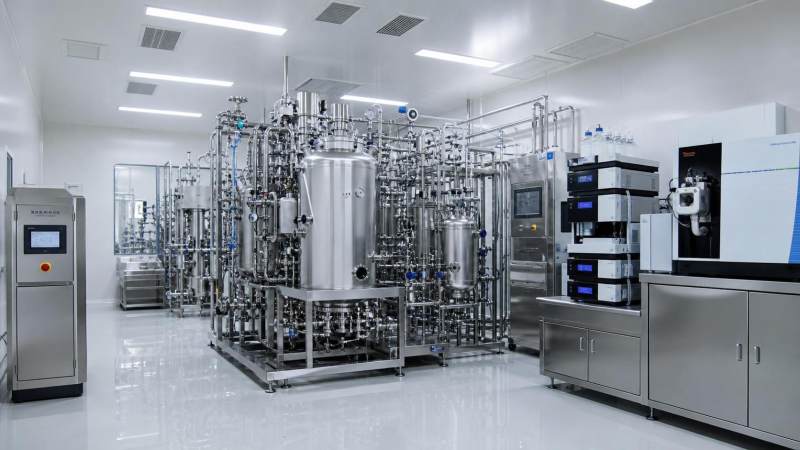
Manufacturing high-purity peptides involves precise sequence-preserving operations, including enzymatic hydrolysis, ultrafiltration, concentration, and spray-drying or freeze-drying (lyophilization). Industry-leading factories equip their facilities with automated Process Control Systems (PCS) within GMP-certified cleanroom environments. Possessing scalable infrastructure—capable of transitioning seamlessly from small-batch pilot runs to multi-ton commercial production—ensures both operational efficiency and rigorous batch-to-batch consistency.
3. Comprehensive Quality Control (QC/QA) and Testing Infrastructure
Quality assurance forms the backbone of bio-ingredient manufacturing. A professional factory operates an in-house analytical testing laboratory equipped with high-precision instruments such as High-Performance Liquid Chromatography (HPLC), Liquid Chromatography-Mass Spectrometry (LC-MS), and Atomic Absorption Spectroscopy (AAS). These tools allow internal QA teams to rigorously screen every batch for peptide purity profiles, molecular weight distribution, heavy metal residues, pesticides, and microbial safety prior to issuing an official Certificate of Analysis (COA).
4. Global Compliance Certifications and Supply Chain Resilience
To facilitate smooth market distribution and support cross-border expansion for client brands, a professional peptide manufacturer establishes internationally recognized quality management systems. These typically include ISO 9001, ISO 22000, and HACCP certifications, alongside regional facility registrations where applicable. Coupled with standardized packaging compatibility testing and international logistics capabilities, the factory ensures product integrity and regulatory compliance throughout the entire delivery pipeline.
Summary
Evaluating a peptide factory’s true manufacturing capability requires a holistic assessment spanning R&D ingenuity, industrial scalability, quality assurance, and global regulatory compliance. Partnering with an end-to-end, fully standardized peptide manufacturer provides brands with a resilient foundation to minimize supply chain risks and achieve sustainable growth in competitive markets.
- Last One:No more articles
- Next Article:How Does a Peptide Factory Guarantee Batch-to-Batch Consistency?2026-07-03